

+971 54 432 6683
drtangclinic@gmail.com

Villa No 7, Opposite Emarat Petrol Station 2,
Al Wasl Road, Al Badaa Area, Dubai - Dubai

Mon – Fri: 9 AM – 10 PM
Sat: 11 AM – 7 PM | Sun: 10 AM – 8:30 PM
What Happens Inside the Body in Multiple Sclerosis? A Clear Explanation

You've heard the name. You've maybe even googled the symptoms. But understanding what multiple sclerosis actually does inside the body — in plain language — can make an enormous difference in how you process what you're reading or what you're experiencing.
This is not a medical lecture. It's a clear, honest explanation of what goes wrong in MS, why it produces the MS symptoms it does, and why those symptoms can look so different from one person to the next.
In short: Multiple Sclerosis (MS) is an autoimmune condition where the immune system attacks myelin — the protective coating of nerves — disrupting signals between the brain and the rest of the body and causing symptoms like numbness, fatigue, vision changes, and muscle weakness.
Your Nervous System Is a Communication Network
Before understanding MS, it helps to understand what it attacks.
Your nervous system is your body's messaging infrastructure — and it works a lot like an electrical grid:
- Brain — the control center that sends every signal
- Spinal cord — the main cable that carries those signals
- Nerves — the wires that deliver messages to every muscle, organ, and sensory point in your body
Every movement you make, every sensation you feel, every image you see travels through this network in fractions of a second. For that to work smoothly, signals need to travel fast and without interference.
That's where myelin comes in.

What Is Myelin and Why Does It Matter?
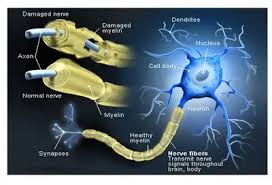
Myelin is the protective coating that wraps around your nerve fibers — think of it like the insulation around an electrical cable.
Its job is to:
- Speed up nerve signals
- Protect the nerve fiber underneath
- Ensure smooth communication between the brain and body
When myelin is healthy, nerve communication is fast and efficient. When it is damaged, signals slow down, get distorted, or stop reaching their destination entirely.
In multiple sclerosis, myelin is exactly what comes under attack.
What MS Actually Does Inside Your Body
Here's where it gets interesting.
MS is an autoimmune condition. That means the immune system — which is supposed to protect you — mistakenly identifies myelin as a threat and begins attacking it.
This sets off a chain reaction:
- Immune system attack begins — The immune system becomes confused and starts targeting myelin in the brain and spinal cord.
- Inflammation develops — This attack creates inflammation around affected nerve fibers.
- Lesions form — Damaged areas, called lesions or scars, appear across the nervous system.
- Signal disruption occurs — Messages between the brain and body slow down, become distorted, or stop completely.
- Symptoms appear — The symptoms depend entirely on which part of the nervous system has been affected.
That last point is important, and it explains a great deal.
How MS Affects Different Parts of the Body
Because MS targets the central nervous system — which controls everything — symptoms can appear almost anywhere in the body. Here is how damage in specific locations translates into specific symptoms.
Brain
When areas of the brain are affected, a person may experience:
- Memory difficulties
- Brain fog and slowed thinking
- Mental and physical fatigue
- Cognitive changes
Spinal Cord
Damage to the spinal cord can lead to:
- Weakness in the arms or legs
- Balance problems
- Difficulty walking
- Numbness or tingling sensations
Optic Nerves
If inflammation affects the optic nerves — the visual pathway — symptoms include:
- Blurred or double vision
- Temporary vision loss
- Eye pain during movement
| Location of Damage | Resulting Symptoms |
|---|---|
| Optic nerves | Blurred vision, double vision, temporary vision loss |
| Brain (cognitive areas) | Memory problems, brain fog, slowed thinking |
| Brain (cerebellum) | Balance issues, coordination difficulties, tremor |
| Spinal cord (upper) | Weakness or numbness in arms and hands |
| Spinal cord (lower) | Leg weakness, difficulty walking, bladder issues |
Why Two People With MS Can Have Completely Different Symptoms
MS does not attack one fixed location. It can affect different areas of the brain, spinal cord, and optic nerves in different people — which is why the symptom picture varies so widely.
One person may experience primarily vision problems. Another may deal mainly with walking difficulties. A third may be most affected by fatigue.
It is the same underlying process, happening in different locations. The location of the damage determines the symptom — not the other way around.
Why MS Symptoms Come and Go
But there is a catch.
One of the most disorienting aspects of MS — especially early on — is that symptoms can appear, improve, and then return again weeks or months later.
This happens because inflammation in the nervous system is not constant. During a relapse, inflammation flares and symptoms worsen, or new ones appear. During remission, inflammation settles and the nervous system partially recovers.
But partial is the key word. Each time damage occurs, some recovery happens — but not always complete recovery. The nervous system can sometimes find alternative pathways to route signals around damaged areas. Over time, if damage continues, some of those changes can become permanent.
This is why the pattern of MS over time — rather than a single episode — is one of the most important things doctors look at during diagnosis.
Is the Nerve Damage Permanent?
Not always — especially in the early stages.
The nervous system has some ability to compensate and partially repair myelin damage. This is why many people experience genuine improvement during remission periods.
However, repeated inflammation and scarring over time can lead to damage that does not fully reverse. This is why early awareness and monitoring matter — not to cause alarm, but because understanding what is happening gives you and your doctor the clearest possible picture.
Why MS Is Genuinely Difficult to Predict
MS does not follow a single fixed path. It varies from person to person because:
- Different nerves are affected in different people
- Damage can occur in multiple locations simultaneously
- Immune activity fluctuates over time
This unpredictability is also why MS cannot be diagnosed from a single test or a single episode. Doctors look for evidence of damage in more than one area of the nervous system, occurring at more than one point in time, before a diagnosis is confirmed.
Frequently Asked Questions
What exactly is damaged in multiple sclerosis?
MS damages myelin — the protective coating around nerve fibers in the brain and spinal cord. When myelin is damaged, nerve signals slow down or fail to reach their destination, which produces the symptoms associated with MS.
Why does MS cause such different symptoms in different people?
Because MS can affect different areas of the nervous system in different people, the resulting symptoms vary widely. One person may experience primarily vision problems while another mainly deals with walking difficulties or fatigue. The location of the damage determines the symptoms.
Can anxiety or stress make MS symptoms worse?
Stress does not cause MS, but many people with MS report that high-stress periods seem to coincide with symptom flares. The relationship between stress and immune activity is complex and remains an active area of research.
Can the body repair myelin damage on its own?
To some extent, yes. The nervous system can partially repair myelin, which is one reason symptoms sometimes improve during remission. However, repeated damage over time can lead to scarring that the body cannot fully reverse.
Why do MS symptoms sometimes disappear and then come back?
This reflects the relapsing-remitting pattern seen in the most common type of MS. Inflammation flares during a relapse, causing symptoms. When inflammation settles during remission, symptoms may partially or fully improve — before potentially returning if another area of the nervous system is later affected.
Does MS affect the whole body directly?
No. MS primarily affects the central nervous system — the brain and spinal cord. However, because the central nervous system controls the entire body, symptoms can appear almost anywhere depending on where the damage occurs.
Can an MRI detect MS early?
MRI is the most important diagnostic tool for MS. It can detect lesions — areas of myelin damage — in the brain and spinal cord, sometimes before symptoms are severe or even noticeable. However, a diagnosis is not based on a single MRI alone; doctors look for lesions in multiple locations and evidence of damage occurring at more than one point in time.
Conclusion
Multiple sclerosis is a complex neurological condition that affects communication between the brain, spinal cord, and the rest of the body. When the immune system mistakenly attacks myelin, it disrupts nerve signals and can lead to symptoms such as vision changes, numbness, fatigue, and coordination difficulties. Because different parts of the nervous system may be involved, the symptoms often vary from person to person.
Understanding what happens inside the body in MS helps make the condition easier to recognize and reduces confusion around its early signs. However, proper diagnosis always requires detailed neurological assessment and professional evaluation.
For patients looking for supportive and integrative care in Dubai, Dr Tang Acupuncture Clinic offers a holistic approach alongside medical guidance, and many individuals explore MS treatment in Dubai at Dr Tang Acupuncture Clinic as part of their journey toward better symptom management and improved well-being.
With early diagnosis, regular monitoring, and a personalized care plan, many people with MS are able to manage symptoms more effectively and maintain a more stable quality of life.